
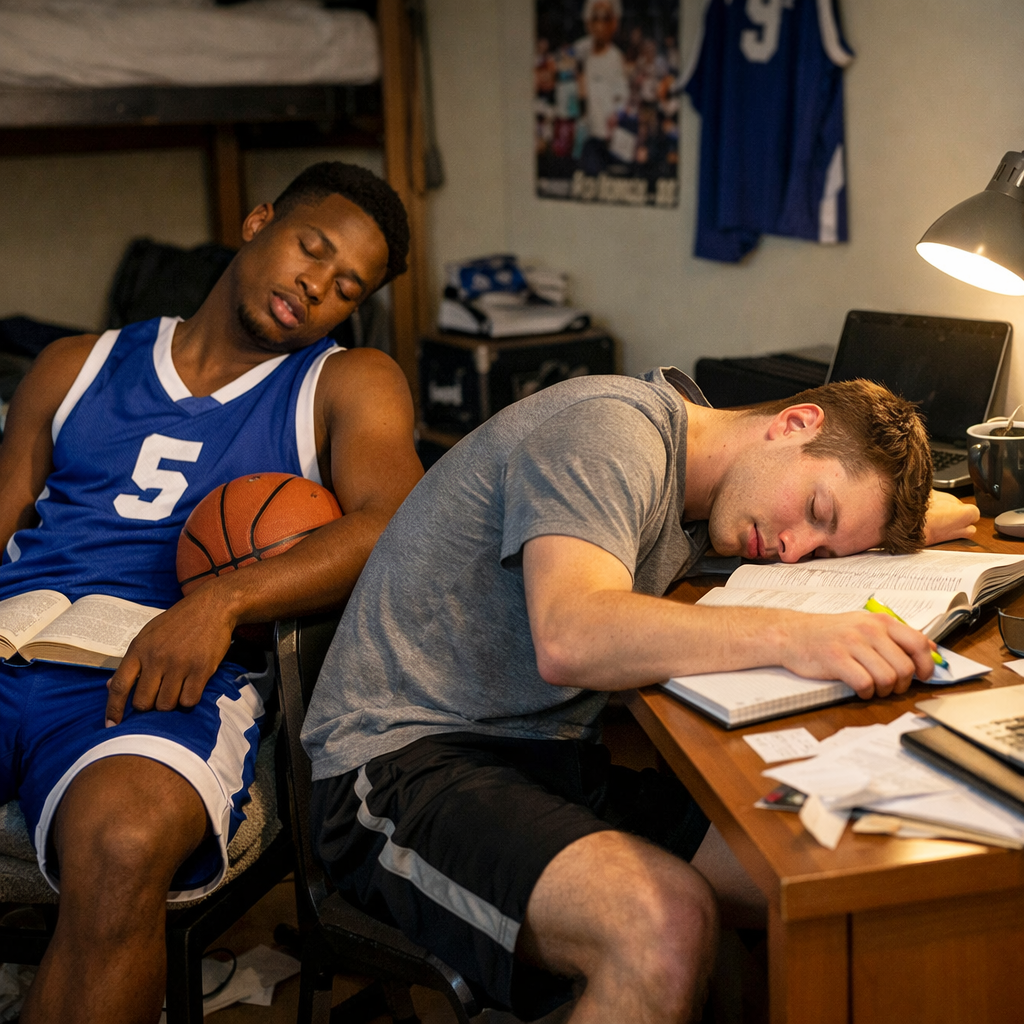
At a time when we hear about some athletes who go on to become brain surgeons, mechanical engineers and business moguls, the old school reference to a “Big Dumb Jock” just doesn’t resonate much these days. Many of these young cats are studying Poly-Sci, Medicine, Aeronautics, Law and many other professional degree programs. And they somehow manage to do it, while playing full time roundball, football or other D-1 sports in college. But how? When do they sleep? Better yet, DO they sleep at all?
With “no-pass/no-play” rules at an all-time high at the high school and college level, one wonders how do these student athletes keep up? How do you play a full season of basketball (…let’s say, at a school like Duke or Tennesse or SMU), and still be able to make the necessary GPA to stay in school and graduate. I used to think maybe they were exempt from classes, during their playing season. Or on the darker side, I figured they had a little (or big) curve system for collegiate athletes, where they didn’t have to do as much in class–not during the season because they simply didn’t have time. You know once upon a time, schools like UNC , Minnesota, The University of Georgia and Florida State University (among others) were subject to fines, athletes were ruled ineligible , wins were vacated and any number of other penalties (back in the late 1990’s-early 2000’s) for alleged improprieties involving athletes. As news media, we covered claims of tutors allegedly completing coursework for football players, counselors heavily editing papers for basketball players so they’d make the grade and even a so-called “Paper Classes” Scandal at Chapel Hill–which required next to no school work or lectures, just a single sheet of paper to pass a class and stay on the team.
Fortunately those days are over. The stakes are too high. The academic “death penalty” is real. But you still must wonder, how are these athletes cutting it in class, with such rigorous game schedules? The rules say, college athletes must attend class (like everybody else) regardless of their game schedules. Some often rely on special policies which allow them to travel with the team, (and get excused absences as a result). But when they get back, guess what? They STILL have to make up those classes, and keep their GPA’s up in order to play. And that begs the question again, what about sleep?
It came to my mind this past weekend, when UCLA Coach Mike Cronin started his post-game press conference, bashing the starting time of his teams game against the Cornhuskers. As it were, The Bruins won the game–they beat the pants off Nebraska in their NCAA Tournament game. But Cronin complained that the games are starting too late– citing the 8pm (West Coast) start, which meant (body clock-wise), Nebraska’s kids actually started at 10pm. Cronin’s beef: These damn kids still have to get up in the morning, regardless of a Sunday game, and go to class–and be expected to do well!
He cited lucrative TV deals which sometimes dictate the starting “Prime time” tip-off of a game. But when and where do you draw the line in advocating for these young athletes? I have to admit, I’m with Cronin, albeit a bit odd that he’s advocating for the opposing team they just beat. And while there are tutors and academic counselors around to make sure these young athletes perform well in class, it doesn’t make up for energy level. I do understand that many athletes are given priority registration so they can pick classes that fit their training and the team’s roster moves and their home and away games. And some might argue it’s what they signed up for. And in this NIL world we live in, many young athletes are expected to “fall in line” even more. But an extra dollar or two in your pocket doesn’t make you superman or superwoman!
NCAA Rules require student athletes to achieve somewhere between 40-45% of their degree program by the end of their junior year in college. Calendar priority or not, it still seems like it’d be a losing proposition to play in a Tournament game on a Sunday night starting at 8…and make it to class refreshed (for a mid-term) by 8am. I’ve heard of D-1 schools back in the 70’s where athletes didn’t really have to go to class at all. It was just “understood” by the professors that they “had to pass those athletic stars”–and to do it for the school. One professor reportedly sued a school, saying her job as a “tutor” turned out to be a job whereby she was charged with convincing other professors to pass students whether they did the work or not. Call me naive, but I would be hard-pressed to believe that anyone at any school would be doing anything like this in our day and time. Plus, I hear at most schools, professors are required to provide status reports on all student athletes on the regular.
But it doesn’t stop you from wondering, “If they are at least making it to class, are they really studying and keeping up, or is there some educational perk to being a star athlete?” Wink-wink. There’s a guy I knew back in school who was the best of the best at football. He was a running back. But I’d often ask myself, “I know damn well this cat can’t be honor roll, when all I see him do is practice, hang out in the gym and sleep”. But then, after graduation (he didn’t go to the pro’s), Dude owns a successful real estate development company.
“Something” went right. And maybe its the same body clock which is in play today, with these kids playing in a full blown tournament on a Sunday night, and sitting in class the next morning at full attention. Maybe its the adrenaline rush of knowing “If I don’t make an A on this paper, I could get kicked off the team for academic suspension”.
Or hell, maybe I’m just old and can’t figure out how they do it. I’m going to sleep. I’ve got a newscast to get to in the morning.
Unk
Leave a Reply