
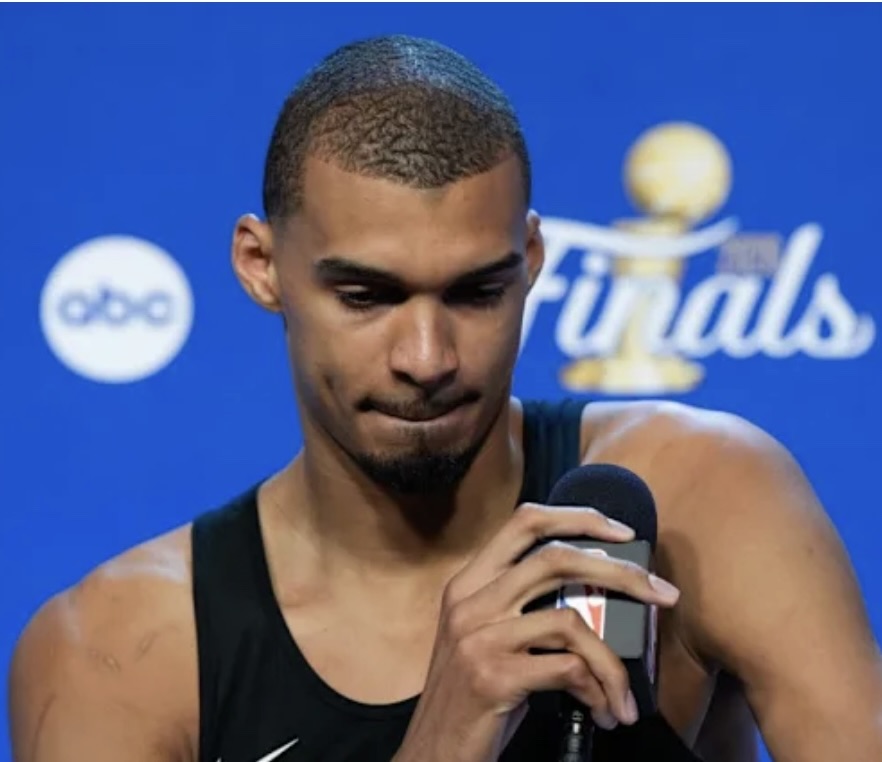
Victor Wembanyama is a phenomenon.
At 7-foot-4, the French superstar has changed the game almost overnight. His defensive presence is unlike anything we’ve seen in years. He blocks shots that shouldn’t be blocked. Alters shots he never touches. Covers parts of the floor most players can’t even reach.
And offensively? He’s only getting started.
What’s perhaps most impressive is how mature he has appeared throughout most of his young career.
Remember, this is a player who arrived in America as a teenager. A different culture. A different language. Different expectations. Different media. Yet for the most part, he has handled the spotlight remarkably well.
That’s why what happened during the postseason caught so many people by surprise.
As the pressure intensified, so did the scrutiny.
After Game 6 of the Western Conference Finals, Wembanyama fulfilled his media obligations but appeared eager to leave. His interview lasted only seconds, with short, clipped answers before he exited.
Technically, he did nothing wrong.
He showed up.
He answered questions.
He complied.
But in today’s sports environment, perception often becomes reality.
Then came the NBA Finals.
After watching his Spurs surrender a 29-point lead in one game and fail to close out another double-digit lead in the deciding contest against New York, Wembanyama understandably appeared frustrated.
Who wouldn’t be?
Championship opportunities don’t come around every day.
During his postgame press conference, he discussed how playoff basketball differs from the regular season. He spoke about officials calling every little infraction and how there is virtually no margin for error when a championship is on the line.
His frustration was visible.
His disappointment was obvious.
Then came the moment that ignited social media.
As the session ended, Wembanyama stood up, thanked reporters and concluded with the words:
“I’ll See yall… never.”
He then walked away.
Now, was he saying he never wanted to see the reporters again?
Probably not.
Was he suggesting he’d never again want to experience the pain of losing a championship series?
Possibly.
Could it have been a language issue, an emotional reaction, or simply an awkward attempt at humor?
Absolutely.
The problem is that he didn’t explain.
And when athletes don’t explain, other people do it for them.
Suddenly, social media was filled with accusations that Wembanyama was being a sore loser. Others defended him. Some called it disrespectful. Others called it understandable.
The debate wasn’t really about what he meant.
It was about what people thought he meant.
That’s an important distinction.
At Next Tally, we teach athletes that communication doesn’t stop with your words. Your body language communicates. Your facial expressions communicate. Your tone communicates. Your exit communicates.
Sometimes what you don’t say becomes a bigger story than what you do say.
That’s the challenge facing Wembanyama today.
Not because he’s a bad person.
Not because he’s immature.
Not because he’s a poor sport.
In fact, his track record suggests quite the opposite.
The challenge is understanding that in American sports culture, cameras don’t just capture moments. They create narratives.
A five-second clip can become a 48-hour news cycle.
One misunderstood comment can overshadow an entire season of professionalism.
Fair or unfair, that’s the reality.
What made the optics even more difficult was what happened immediately after the final buzzer. Knicks star Jalen Brunson crossed the floor to embrace Spurs coach Mitch Johnson and offer words of encouragement. Television cameras captured that moment.
What they didn’t appear to capture was any immediate public congratulatory exchange involving Wembanyama and the Knicks.
Again, that doesn’t mean it didn’t happen.
It means people didn’t see it.
And in today’s media environment, what people don’t see often becomes part of the story.
The good news for Wembanyama is that this is entirely fixable.
Because unlike a physical flaw in his game, perception can be managed.
Communication can be learned.
Media awareness can be taught.
Understanding how comments, gestures and body language are interpreted is a skill just like shooting, passing or defending.
Victor Wembanyama remains one of the brightest young stars in professional sports. He remains a generational talent. He remains the future face of the NBA.
But if there’s one lesson from this postseason, it’s the same lesson we teach every athlete who walks through the doors at Next Tally:
Talent gets you noticed.
Character and control keep you in the game.
The difference between being understood and being misunderstood can sometimes be just one sentence.
And sometimes, it’s three words.
“See y’all never.”- Unk
Leave a Reply